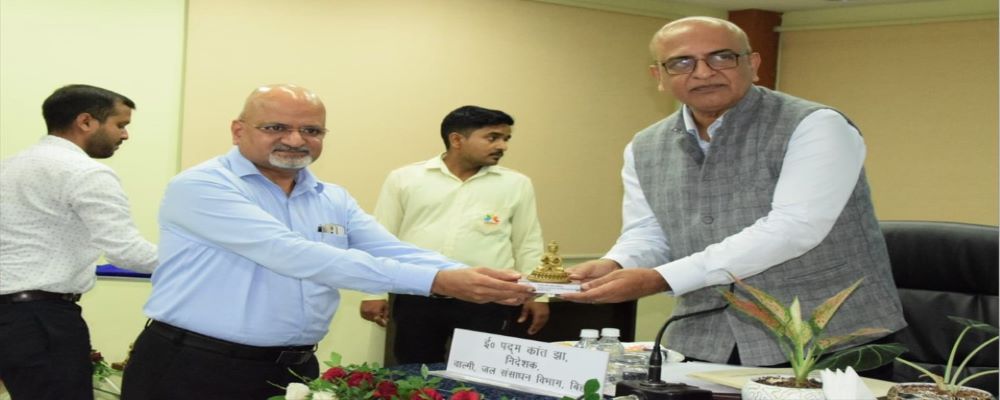
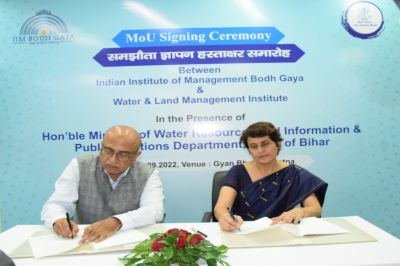
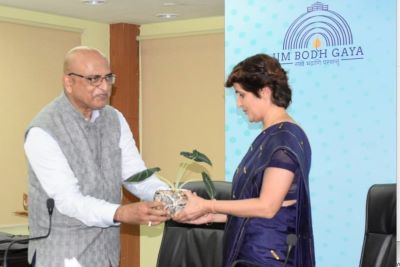
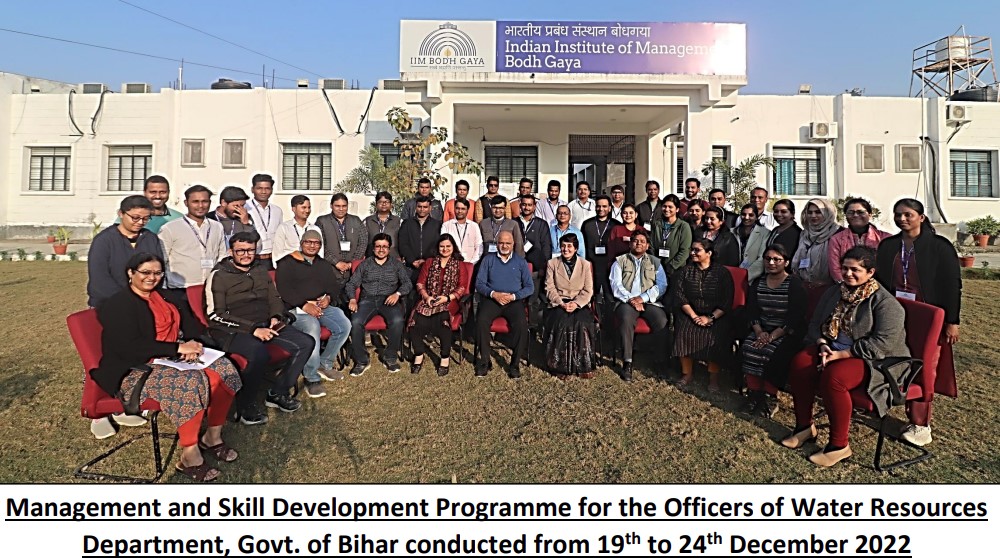
Memorandum of understanding entered into and executed on 30th September 2022 between Water
Resource Department (WRD) & Indian Institute of Management, Bodh Gaya (IIMBG) at Gayan Bhawan
Patna. IIMBG would provide customised management training to WRD engineers. It will help in
improving leadership quality and Management Skills in WRD engineers.
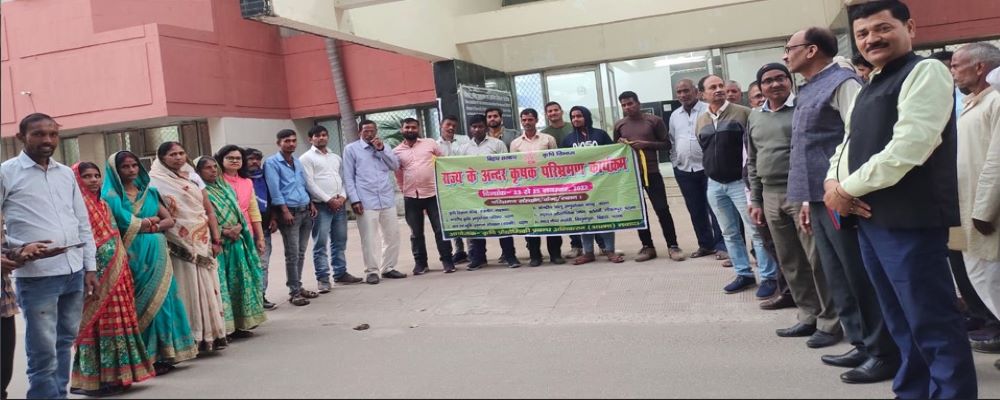
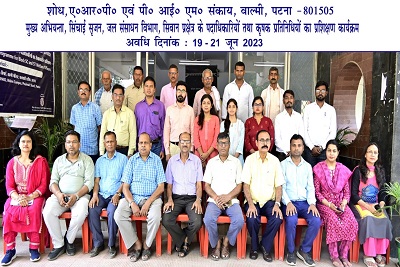
The Institute organizes regular training programmes for the senior, middle and junior level officers of all Works Departments of Bihar including Water Resources Department, Agriculture Department and farmers, the overall objectives of the training courses are to strengthen the capability of the trainees to design, operate, maintain and manage different engineering systems of various Works Departments and to enhance the utility of water and land resources and to manage the irrigation systems under the ambit of Water Resources Department specifically. Scientific developments and efficient management of farms are emphasized during the training.
Annual Training Programme 2023-2024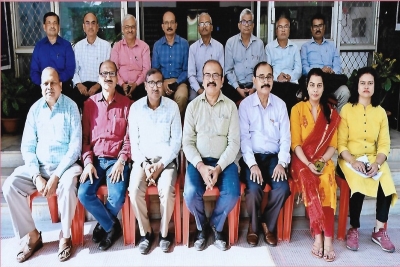

WALMI, Patna arranges a number of seminars & workshops on different
subjects related to Agriculture, Water and Land Management and on other topics also
which enables our engineers to get updated. In year, 2017 & 2019 workshop & conferences organized
by WALMI are as follows.
• State Level workshop on Benchmarking of Irrigation Projects at WALMI, Patna (Period 28-29 Jan, 2019).
Organised by Ministry of Water Resoures, River Development & Ganga Rejuvanation, R&D Division Govt. Of India,
New Delhi and Water Resources Department(GOB).
• International conference "Incessant Ganga" Feb 25 and 26, 2017, Patna, Bihar Organized by Water & Land Management Institute,
Phulwari Sharif,Patna-801505.
The success of a scheme/project depends on efficient management and feed back. In this back-ground, Action Research programme (ARP) was introduced in June 1988 to enhance the efficiency of an existing irrigation system. Paliganj distributary was first to be taken up under this programme and the result was encouraging.
According to the National Water Policy, the management of all the Canal systems is to be transferred to the Beneficiary Committee under the PIM programme in a phased manner. There will be a System Level Committee(SLC) for each irrigation system and a Village Level Committee(VLC) in each of the villages under irrigation command. The System Level Committee is registered under the Societies Registration Act, 1860. It is the responsibility of those committees to assess and collect taxes against irrigated area. The Committee has to provide 30% of the collected amount to the government and the remaining 70% of the amount are to be used for the maintenance of its canal system. The achievement of this program on 31st March, 2020 is as follows:-
| S.No. | Updated Status of Farmers Committee | No. |
|---|---|---|
| 1 | Management transferred Irrigation system | 64 |
| 2 | Farmers Committee formed to get transfer | 17 |
| 3 | Applied for Registration | 30 |
| 4 | In the process of Motivation | 511 |
Climate change is one of the most critical global challenges of our
times. Recent events have emphatically demonstrated our growing
vulnerability to climate change. Climate change impacts will range from
affecting agriculture – further endangering food security – to sea-level
rise and the accelerated erosion of coastal zones, increasing intensity
of natural disasters, species extinction, and the spread of vector-borne
diseases.
National Action Plan for Climate Change (NAPCC) is a Government of
India's programme launched in 2008 to mitigate and adapt to the adverse
impact of climate change. The action plan was launched in 2008 with
eight sub-missions. The plan aims at fulfilling India's developmental
objectives with focus on reducing emission intensity of its economy. The
plan will rely on the support from the developed countries with the
prime focus of keeping its carbon emissions below the developed
economies at any point of time. The eight missions under NAPCC are as
follows:-
• National Solar Mission.
• National Mission for Enhanced Energy Efficiency.
• National Mission on Sustainable Habitat.
• National Water Mission.
• National Mission for Sustaining Himalayan Ecosystem.
• Green India Mission.
• National Mission for Sustainable Agriculture.
• National Mission on Strategic Knowledge for Climate Change.
Under National Action Plan on Climate Change driven by Ministry of
Environment, Forest and Climate Change, Govt. of India, every State has
to prepare their State Action Plan for Climate Change (SAPCC). For
formulation of Bihar State Action Plan for Cliamate Change (BSAPCC),
Environment, Forest and Climate Change Department, Govt. of Bihar is the
nodal department. Water Resources Department, Govt. of Bihar is
responsible for water sector. WALMI, Patna has been nominated as a Nodal
Agency for formulation of this work by WRD, Bihar.
BSAPCC has already been formulated in 2015. But Government of India has
directed to revise it in the light of Indian Nationally Determined
Contributions (INDCs) in context of United Nations Climate Change
Conference, 2015 held in 2015 in Paris. This conference was attended by
Hon’ble Prime Minister, India.
WRD, Bihar has already submitted its part on water sector of BSAPCC to
the nodal department, Environment, Forest and Climate Change, Govt. of
Bihar.
Background of the Work :
Ministry of Water Resources, Government of India has launched National
Water Mission (NWM) as one of the eight National Missions, which form
the core of the National Action Plan for Climate Change (NAPCC),
launched by the Hon’ble Prime Minister.
The main objective of the National Water Mission is
“conservation of water, minimizing wastage and ensuring its more
equitable distribution both across and within State through integrated
water resources development and management”.
The Comprehensive Mission Document of “National Water Mission” has
identified following five goals;
I. Comprehensive water data base in public domain and assessment of the
impact of climate change on water resource.
II. Promotion of citizen and state actions for water conservation,
augmentation and preservation.
III. Focused attention to vulnerable areas including over-exploited
areas.
IV. Increasing water use efficiency by 20%, and
V. Promotion of basin level integrated water resources management.
In order to achieve these objectives in a holistic manner, NWM envisages
preparation of State Specific Action Plan (SSAP) for water sector of
each State/UT aligning with the State Actions Plans of Climate Change.
The SSAP for water sector needs to be formulated based on scientific
assessment of the climate vulnerability to climate change which will
help in identifying and prioritizing mitigation/adaptation strategies;
climate change projections; Green House Gas (GHG) emissions etc.
Objectives of SSAP for water sector :
(a) Critical analysis of existing water scenario based on current and
past data / information-both on availability and development (supply
side) and use (demand side).
(b) Critical review of existing water policies, regulations,
institutions and various ongoing interventions / Schemes / Programmes on
Water being undertaken by various government and
non-government agencies including the best practices.
(c) To identify current and future development needs, challenges;
vulnerable areas and communities; and explore possible solutions and
strategies for sustainable development and
management.
(d) To formulate annual State / UT Water Budgets.
(e) To document assessment / Impact of Climate Change on the
State-resources, livelihoods and growth from Water perspective and the
development of possible scenarios on Water.
(f) To formulate and strategic action plan including location and
context specific contingency plans to manage the impact of climate
change.
(g) To formulate a comprehensive and integrated plan for Water Security,
Safety and Sustainability with equity through convergence, synergy and
role / accountability of all stakeholders - Government and
Non-Government agencies including civil society.
National Institute of Hydrology (NIH), Roorkee has been designated as
Nodal agency to coordinate the formulation of SSAP for water for Bihar
State. Water Resources Department (WRD), Government of Bihar has been
identified as the Nodal department and WALMI, Patna has been nominated
by WRD, Bihar as the Nodal agency for formulation of this work in
Bihar.
IIT, Patna has been nominated as the Consultant to do this work by
WALMI, Patna with the approval of WRD, Government of Bihar. The
MoU/Agreement between WALMI, Patna and IIT, Patna has been signed.
Mobilization advance has been given to IIT, Patna and they have started
the work on this.
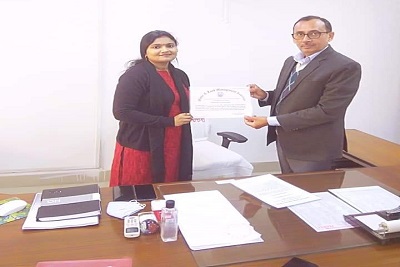
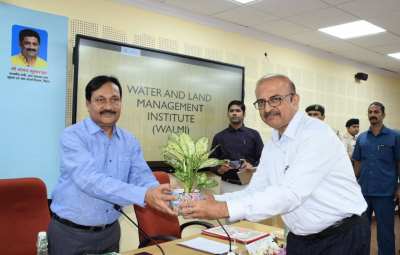
Mrs. Varsha Verma, B.E (Electronics & Communication) has developed this website for WALMI, Patna.
As a token of appreciation, then Director, WALMI, Dr. Ishwar Chandra Thakur
presented a certificate of appreciation to Mrs. Verma.